

Customers today don't buy products. They buy choices. The way you curate and present those choices can make or break your business. This is where product assortment comes into the spotlight. Contrary to popular belief, it's not just an operational decision about what to stock. It's a strategic framework. One that shapes how your brand is perceived and how customers engage. In this article, we'll break down what product assortment truly means and why it's critical to your business success. We will also highlight some key strategies that can help you stand out with just your assortment.
Product assortment refers to the mix of products your business offers. It typically constitutes the number of products sold, their variations, and the depth and breadth of your selection.
Instead of just occupying space in the catalog, a well-planned assortment creates better shopping experiences for your buyers and drives higher sales for you.
For instance, a strong product assortment for an electronics retailer might comprise a wide range of products, including smartphones, laptops, home appliances, accessories, etc. This wide assortment appeals to a broad audience.
On the other hand, a specialty audio store may focus on a narrow but deeper assortment, including premium headphones, earphones, speakers, home theaters, and amplifiers. This appeals to only audiophiles seeking expert quality.
To build a strong product assortment, it's essential to understand the key components that define its structure. Here they are:

Breadth refers to the number of distinct product categories your business offers. A wider product breadth simply means you cater to a broader audience. On the other hand, a narrower breadth is all about specialization. For example, an electronics retailer offering laptops, smartphones, televisions, home appliances, and audio systems demonstrates wide breadth.
Depth refers to how many variations exist within a single product category. This can include differences in size, color, brand, or even features. A deep assortment allows your business to cater to specific customer preferences. For example, a laptop store offering only 10 models of laptops, each with different configurations, shows strong product depth.
Length represents the total number of individual products (or SKUs) your business offers across all categories. It gives a complete picture of your business's overall inventory size. For example, a supermarket selling 2,000 unique items across electronics and hardware has a long product assortment.
Consistency indicates how closely related your product lines are. It could be in terms of use, features, production, or even target audience. High consistency allows you to maintain a strong brand identity and operational efficiency. A lower consistency, on the other hand, can help diversify your risk and reach new markets. For example, a tech retailer that sells monitors, laptops, and printers maintains high consistency because all products serve the same customer base and fall under the electronics category.
Quality mix refers to the balance of low-end, mid-range, and premium products offered to meet diverse customer expectations. A well-designed quality mix ensures that your business attracts both budget-conscious shoppers and those seeking premium experiences. A smartphone retailer that sells affordable entry-level phones and flagship devices successfully caters to multiple customer segments through a strong quality mix.
A well-planned product assortment might seem like it's all about variety. But it's a key driver of sales and customer satisfaction. Here are some of the key benefits of selling a well-planned product assortment:
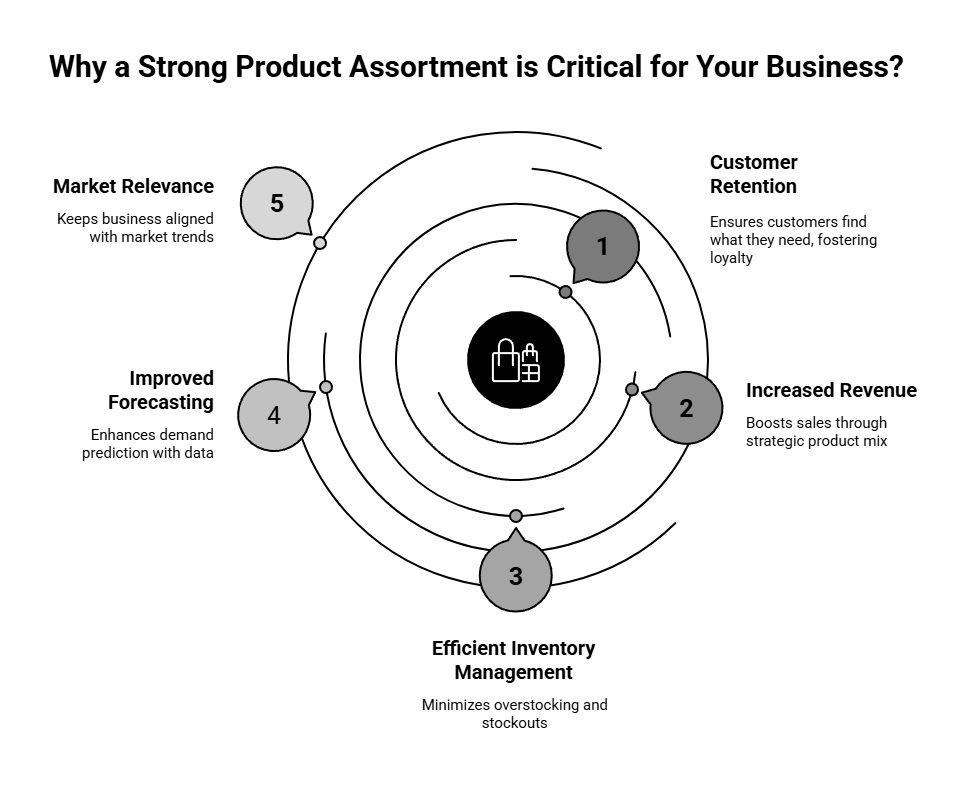
A well-planned product assortment ensures customers consistently find what they're looking for. It could be their favorite product or a new alternative that meets their needs. This reliability and accessibility lead to trust and satisfaction, encouraging repeat purchases for your business.
By maintaining the right mix of high-demand products and complementary items, you can increase average order values and reduce missed sales opportunities. A balanced assortment strategy also helps capitalize on cross-selling and upselling opportunities. This invariably drives steady revenue growth.
A focused assortment strategy minimizes the risk of both overstocking and stockouts. For instance, by concentrating on products that perform well, you can reduce holding costs and free up capital for other growth activities. The result is a lean, agile inventory that maximizes efficiency. At the same time, you ensure product availability when it matters most.
When assortment planning is backed by accurate data and insights, your forecasting becomes more accurate. You can better anticipate demand fluctuations and align procurement with actual customer behavior. This data-driven approach ensures that your supply consistently matches real-world demand.
Customer preferences evolve with trends and seasons. The same rule applies to your products, too. Regularly reviewing and adjusting product mix keeps your business relevant. In other words, you cater to what the market actually wants. This adaptability strengthens your competitive edge and positions your brand as both responsive and forward-thinking.
The road to strong product assortment is not without obstacles. Here are some common challenges you might encounter while managing product assortments:

When you offer too many product variations, your customers can quickly become overwhelmed by choice. This confusion often leads to decision fatigue and lower conversion rates. From an operational standpoint, over-assortment also increases your storage costs and complicates inventory management.
Offering too few choices can limit customer satisfaction and push your buyers toward competitors who provide more options. Under-assortment often results from overly conservative stocking or a lack of market insight.
Consumer preferences evolve rapidly, influenced by trends and shifting lifestyles. A product assortment that worked well last season may no longer appeal to your current buyers. If you fail to monitor and respond to these changes, you risk losing relevance.
Effective assortment planning depends on accurate, integrated data from sales and inventory. However, when data is fragmented across systems, decision-makers lack a unified view of performance. These silos lead to inaccurate demand forecasts and missed sales opportunities.
Here are 5 battle-tested strategies that can help optimize product assortment for any type of business:
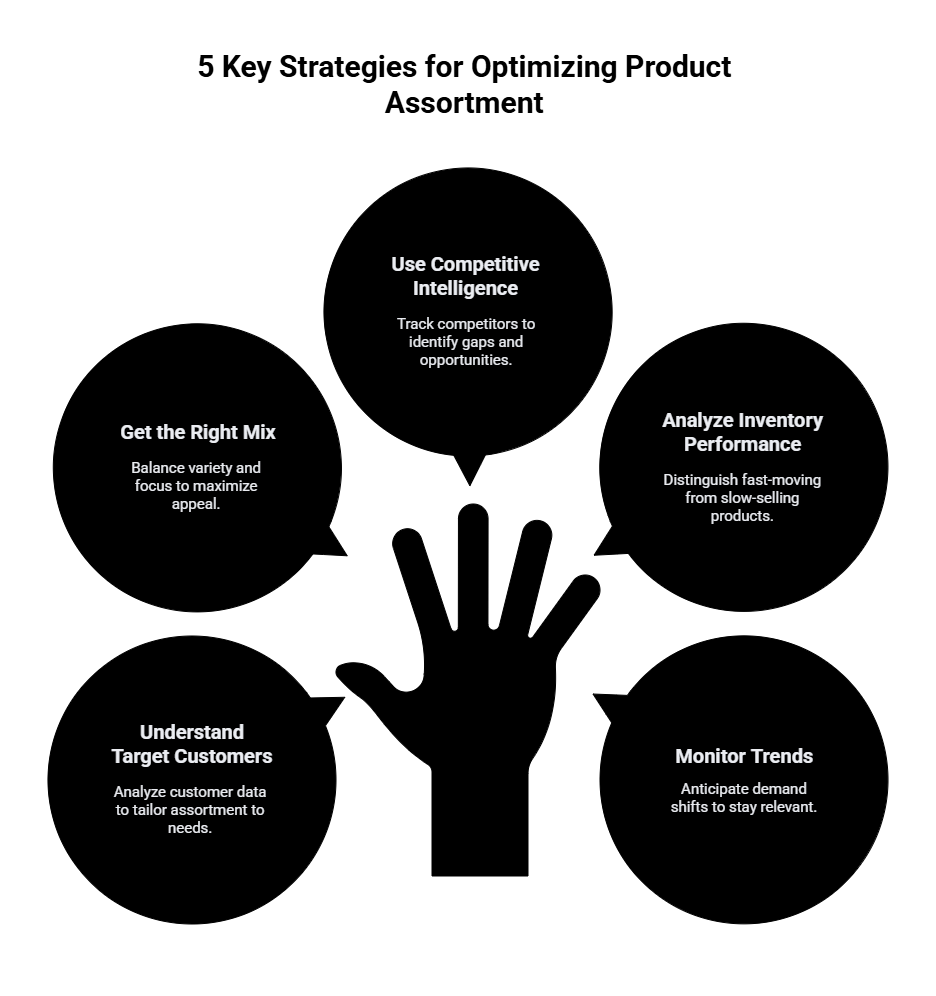
A good assortment plan always starts with knowing who your customers are and what they need. Using your CRM or analytics tool, you can analyze your customer demographics and buying patterns across all sales channels. This helps in determining the right assortment breadth and depth that resonates with your core audience.
A well-optimized product assortment starts with achieving the right balance between variety and focus. This means identifying which categories and price points best reflect your customers' preferences and purchase behavior. Having too many similar products can dilute your sales. Too few can limit customer choice. The goal is to create a mix that maximizes appeal without overwhelming buyers or the inventory systems.
Pricing plays a vital role in assortment performance. Monitoring competitor pricing and promotions helps ensure that your product mix remains both attractive and profitable. Advanced pricing intelligence tools like Anakin can identify pricing gaps and highlight which items should be featured or discounted based on competitor data. Such valuable insights ensure that each product is positioned effectively to drive conversions and maintain healthy margins.
Regular inventory analysis can help you distinguish between fast-moving and underperforming products. Using real-time sales and stock data, it is possible to fine-tune the assortment further. For instance, expanding high-demand lines and discontinuing slow sellers. This data-driven approach minimizes overstock and reduces storage costs.
Customer preferences evolve constantly. Tracking what the audience is buying, when, and why helps anticipate demand shifts before they occur. Integrating these insights into the assortment strategy ensures that the offerings stay timely and competitive, keeping the catalog aligned with real-world consumer demand.
A well-planned product assortment is more than just a collection of items. It's a strategic approach that connects customer needs with business goals. By finding the right balance between breadth, depth, and quality, businesses can create meaningful shopping experiences that drive loyalty and profitability. When supported by strong competitive intelligence, product assortment becomes a key tool for staying agile and ahead in any market.
Written by Anakin Team