

You list a branded sneakers at an attractive price of $199, thinking you're competitive. A few hours later, Walmart drops the price of the same sneakers to $189. Amazon follows suit shortly. Suddenly, your listing looks overpriced in the market. Your sales stall. This isn't bad luck. It's the reality of selling in a market driven by ecommerce price intelligence.
Your competitors are using automated tools to track and respond to price changes in real time. If you're not doing the same, you're falling behind big time. In this definitive guide, we'll break down how ecommerce pricing intelligence works, why it matters, and how to implement it in your business using price intelligence software.
Ecommerce price intelligence is the process of monitoring and responding to your competitors' pricing strategies in real time. It involves scraping data from competitors' catalogs or portals and visualizing the collected data through dashboards or reports. You can use it to understand how products are priced across the market, identify pricing opportunities, and finally adjust your own prices to attract customers and drive sales.
There are two main reasons why price intelligence is a necessity in today's competitive ecommerce world:
Whether you're launching a new product, planning a flash sale, navigating a seasonal surge, or simply realigning prices for your products, price intelligence helps ensure your price points always hit the mark. You effectively achieve a delicate balance between profitability and customer appeal.
Consider the case of Tuft Needle, the mattress brand that used competitive pricing intelligence to "price right" in the premium mattress market. Its closest competitor, Casper Sleep, was offering a queen-sized mattress for over $1,000 (thanks to strong branding and perceived quality!).
Tuft & Needle launched a comparable high-quality mattress but found that the ideal price in the market for such a mattress was close to $600. They used this critical insight to price their mattress at just $595, around 40% lower than Casper Sleep. This intelligence helped Tuft & Needle capture the value-conscious customer segment who might have otherwise chosen the more expensive Casper.

Beyond just tracking competitors, online price intelligence uncovers hidden gaps in the market. Is there a specific price range where conversion rates spike? Are there opportunities for price bundling or volume discounts? Is there a product that can act as a gateway to long-term customer value? It provides answers to such critical questions, which, in turn, help you reposition your offerings, whether it involves bundling strategically, matching prices, or entering untapped segments in the market.
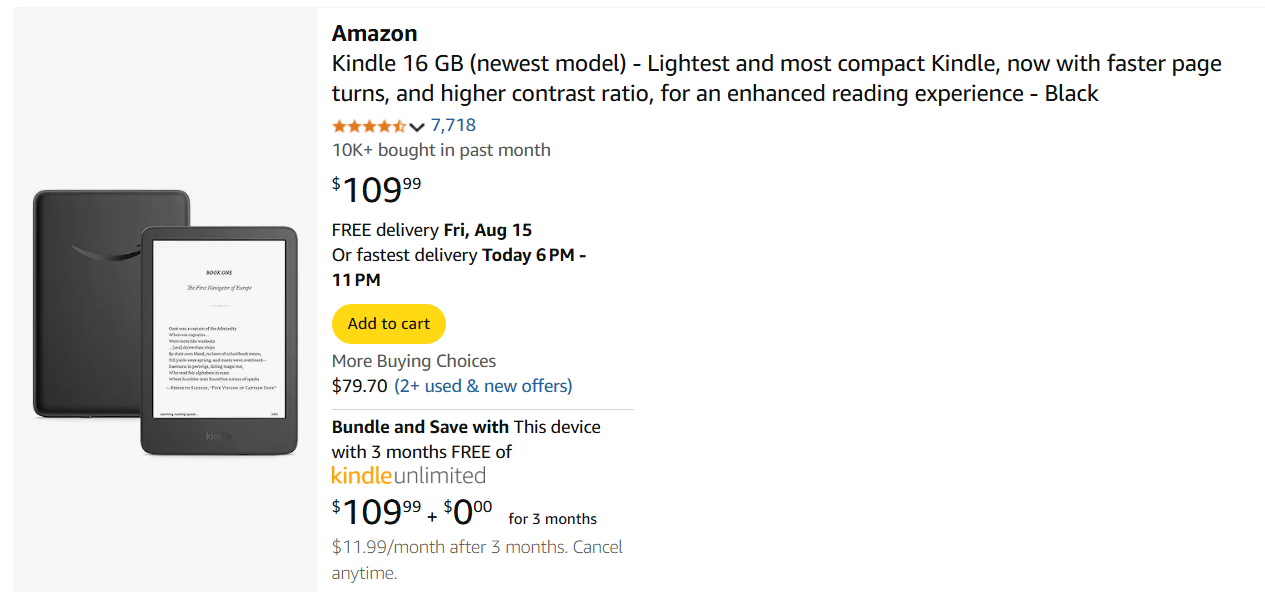
For instance, Amazon Kindle uncovered a hidden opportunity via price intelligence. Instead of competing purely on the initial device (tablets and other book readers) price like its competitors, they offered Kindle devices at very low prices (sometimes at a loss!). This strategy opened the door to recurring high-margin sales from e-book purchases and subscriptions. By identifying that the real revenue lay in repeat content purchases, not just the one-time device sale, they tapped into an overlooked profit stream.
Adopting ecommerce price intelligence is not an overnight task. It involves careful planning and strategic execution, right from picking the right tool to smartly utilizing the generated insights. Here are the key steps involved in adopting ecommerce price intelligence:
First and foremost, determine who you're up against. This doesn't mean tracking every online retailer on the planet. Focus instead on those who actually influence your customers' buying decisions. These might include direct competitors selling identical SKUs. Or larger marketplaces with overlapping offerings.
For example, Target clearly knows that their competitors are Amazon and Walmart (evident from their Price Match policy) because nobody else can offer a price that can sway their customers' decisions.

If you are targeting specific regions, it's also important to monitor localized competitors whose pricing strategies may differ from global players. When you identify the right set of competitors to monitor, you ensure your intelligence efforts stay focused.
💡 Pro Tip: Use data to validate who your real competitors are. Analyze where your traffic is leaking. Which sites show up alongside you in Google Shopping? And what brands do your customers mention in reviews?
Manual price tracking is time-consuming (extremely!). Unless you have massive resources to spare and are okay with frequent human errors, you need to invest in price intelligence software. Modern price intelligence platforms offer accurate insights by continuously tracking data around pricing, product availability, sellers, promos, and even product attributes.
But don't forget the simple thumb rule for picking the right platform - It should be able to handle growing demands over time, whether it's an expanding product catalog, more frequent pricing updates, or the need to support additional regions and markets.
It's time to put your price intelligence tool to work. Start by configuring the tool to track the right competitors and products. Pay close attention to how often you should collect data.
Some platforms offer monthly or weekly snapshots. More advanced solutions can refresh data every few hours, or even every 15 minutes. Choose a frequency that matches the speed of your market. For instance, if you are in a fast-moving industry like fashion, real-time or near-real-time updates are necessary.
💡 Pro Tip: Don't set up the tool and forget it. Revisit your tracking setup regularly. After all, new competitors can emerge anytime, or your existing competitors' catalogs can evolve.
Collecting data is only useful if you turn it into actionable insight. At this stage, you should begin analyzing how your prices compare to competitors. Are you consistently priced higher or lower? Are there specific SKUs where your prices are out of sync with the market?
Benchmarking your catalog this way helps identify opportunities to optimize pricing and protect margins. To analyze and benchmark, you can use the visual dashboards and data tables generated by the tool to spot patterns and trends.
💡 Pro Tip: When benchmarking your catalog, don't treat it as a single block. Break it down by product category. Use it to determine where you can afford to be aggressive and where it's better to hold margins.
Ecommerce price intelligence should not function in a silo. It has the ability to bring positive changes across your different teams, like marketing, sales, product management, inventory, or even customer support.
For example, your marketing team can use competitive pricing insights to sharpen ad messaging, while inventory teams can adjust pricing to move stagnant stock. Product managers, too, can identify saturated categories and redirect focus to higher-potential segments.
💡 Pro Tip: Democratize the intelligence. Share reports or dashboards across teams. When everyone speaks the same pricing language, pricing strategy becomes far more impactful.
We know that today's ecommerce brands don't just compete in one marketplace or currency. They operate (or plan to operate) across geographies and platforms. Anakin was custom-made for such fast-growing brands.
This means pricing intelligence isn't lost in translation; it's localized and actionable. Book a free demo to learn more about Anakin's global intelligence capabilities.
Written by Anakin Team