

Static pricing strategies are not enough in today's competitive e-commerce market. Customers pay close attention to prices, and market conditions change quickly. Dynamic pricing helps keep up with these aspects. It automatically adjusts prices based on live data provided, such as demand, competitor prices, and inventory levels. This helps businesses stay responsive and profitable.
Keep reading to learn how dynamic pricing can help your e-commerce business:
Dynamic pricing is also called real-time or surge pricing. It's a pricing strategy that automatically changes product prices based on live market conditions. Instead of having fixed prices, dynamic pricing looks at things like customer demand, competitor prices, and stock levels. For example, if demand goes up or inventory is low, prices can be increased to boost profits. If a competitor lowers their price, dynamic pricing lets you quickly respond by lowering yours too.
Dynamic pricing in e-commerce helps businesses instantly react to market changes. This way, you won't miss out on sales or lose customers to lower-priced competitors. It provides flexibility and control. You can increase profit margins when demand is high and clear inventory during slower periods. Adjusting quickly is very important for e-commerce businesses to grow and succeed.
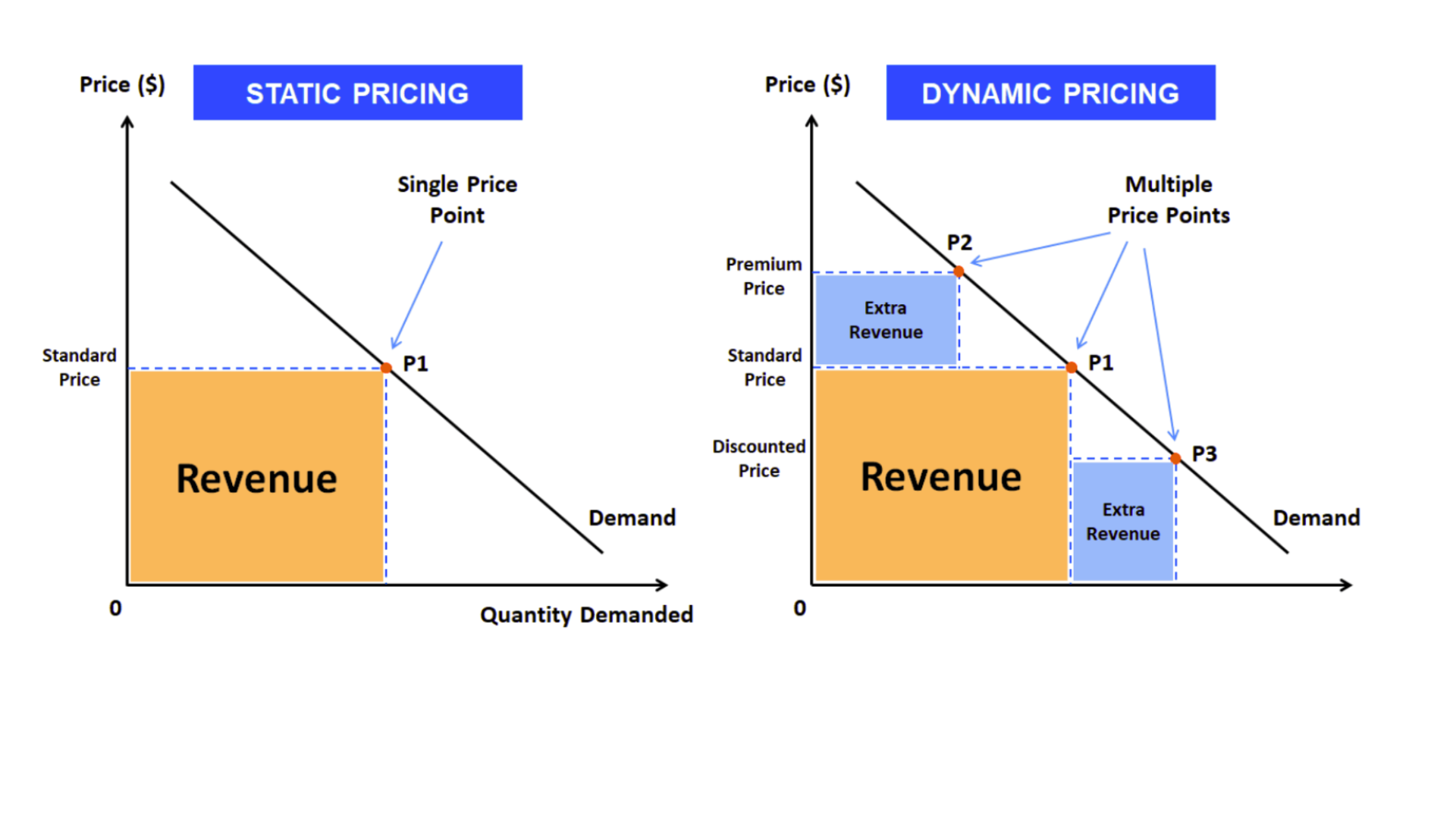
Source: Economics Online
This graph shows the difference between static pricing and dynamic pricing. On the left, static pricing uses one fixed price (P1) for all customers. This creates a limited amount of revenue, shown in orange. On the right, dynamic pricing uses different prices (P2, P1, and P3) depending on demand. When demand is high, prices should go up (P2). When demand is low, prices should go down (P3). This helps the business earn extra revenue, shown in blue. Dynamic pricing allows companies to generate more revenue by adjusting prices based on how much people are willing to pay.
Dynamic pricing uses algorithms and AI tools to change prices automatically based on real-time data. These systems follow pricing rules and adjust prices without needing manual changes:
Demand Levels: The system watches how fast products are selling. If a product is selling quickly, the price goes up to make the most of the demand. If sales slow down, the system lowers the price to encourage more people to buy. This helps increase revenue by responding to changes in demand.
Competitor-Based Pricing: Competitive intelligence is at the heart of dynamic pricing. This can be carried out by inputting data of competitor prices into the algorithm. If competitors raise prices or run out of stock, your price can be optimized upward to increase profit; if competitors drop prices, your pricing can be quickly adjusted to remain attractive. This competitor-based pricing approach ensures you're not underpriced or overpriced relative to the market at any given time.
With Anakin's robust and reliable data solutions, you'll gain access to highly accurate, real-time data—enabling your systems to make smarter, more accurate, and profitable decisions.
Inventory and Supply: Inventory levels of the product feed into the pricing rules as well. When inventory is abundant, the system may offer discounts or promotions to accelerate sales. When inventory is limited, prices may be kept higher to extend the product availability and improve the per-unit margin. Tying pricing to inventory levels helps avoid stockouts (by moderating demand with higher prices) and prevent overstock (by reducing the price of items that are sitting too long).
For instance, during flash sales or seasonal campaigns (e.g., End-of-Season Sales or Big Billion Days) where deep discounts are prevalent, scraping SKUs multiple times daily (such as at the start and end of business hours) offers real-time insights into inventory fluctuations. This allows businesses to pinpoint high-demand products versus slower movers, improve assortment management, and proactively address stocking gaps. By understanding consumer trends in real-time, organizations can optimize their offerings and capitalize on campaign-driven sales opportunities.
Some platforms incorporate variables like time of day, seasonality, or customer behavior. These engines operate using rule-based logic or machine learning models and can update prices across multiple channels several times per hour.
Implementing dynamic pricing at scale requires technology and data. Several tools help in optimizing this process:
By partnering with competitor intelligence platforms that continuously track competitors' prices across e-commerce sites, marketplaces, and even direct-to-consumer (DTC) channels. You can gain valuable data on:
Your dynamic pricing tool can analyze this information in real time. With these insights, you can make smarter pricing decisions. You can choose to match or beat a competitor's price. You can hold your prices steady if you offer greater perceived value. You can also quickly adjust promotions to stay ahead of your competition. For example, an online electronics store monitors rival prices for top-selling SKUs and automatically reduces pricing when a major competitor offers a flash sale.
Use real-time competitor data to A/B test how much undercutting influences sales versus margin erosion.
Rule-based repricing tools allow e-commerce managers to set up custom pricing logic based on business objectives. These rules may include:
Once configured, these engines run autonomously with the provided competitor data, updating prices based on current market conditions and pre-defined logic. They're especially useful for businesses with large product catalogs that would be impossible to manage manually.
Benefits:
While rule-based systems rely on human-defined logic, AI-powered tools take things a step further. These platforms use machine learning models to identify pricing patterns, forecast demand, and recommend or implement optimal prices in real time.
They may consider dozens of variables including:
Over time, the AI engine learns what works and continuously refines its pricing recommendations. These platforms are especially effective in fast-moving, high-volume e-commerce environments like marketplaces, travel, and consumer electronics.
Some generative AI tools may even adapt promotional copy or personalized offers alongside dynamic pricing changes.
These tools also offer dashboard views and analytics reports to help pricing teams make informed decisions on future strategies. Dashboards typically include:
This visibility enables your product managers, procurement officers, and pricing strategists to test new pricing strategies, monitor effectiveness, and adjust rules or models as needed.
Track longitudinal data on pricing changes to understand which segments respond best to surge pricing and which prefer stable prices.
Decide whether you want to maximize profit, increase market share, or move excess stock. The correct dynamic pricing rules flow from these goals.
Capping price increases or frequency of changes can prevent customers from feeling manipulated.
Communicate clearly if your prices vary by region or demand level, especially in heavily regulated sectors like travel.
Start with rule-based scenarios for a subset of products or services. Use analytics to gauge effectiveness and refine.
Dynamic pricing is important for e-commerce businesses. It automatically adjusts prices based on competitors and customer demand. This helps businesses respond quickly and stay customer-focused. When done transparently and with clear guidelines, dynamic pricing increases profits. It also builds customer trust and keeps your business relevant. For e-commerce leaders, dynamic pricing is an effective way to stay competitive in a changing market.
Written by Anakin Team