


If you've been playing the price-matching game until now, it's time to hit the pause button. Pricing algorithms are working tirelessly behind the scenes, helping your competitors take control of prices rather than reacting to you or the market. To edge past them, you need to transition from "basic price matching" to "absolute price mastery" through competitive intelligence. But first, let's understand what's wrong with price matching when performed in isolation.
Price matching has become a default tactic for most retailers today. Why? One probable reason could be that it's very easy to implement: a competitor drops prices, you match it to avoid losing customers.
While price matching is an effective way to protect sales, it is still an out-and-out defense mechanism. It keeps you locked into perennial reaction mode, and your every decision is dictated by what someone else does. Eventually, you lose the ability to make proactive choices about your own value proposition.
Retailers who lean too heavily on price matching in silo also end up falling into the notorious price-matching trap.
The price-matching trap occurs when two retailers continuously slash prices to match the other's move. While it may seem harmless at first, it often spirals into price wars, a race to the bottom that damages profitability and dilutes brand value.
Take the case of Best Buy, which almost fell into the price matching trap. To keep up with Amazon, they aggressively price-matched nearly every offer. While it helped them avoid immediate customer churn, it also squeezed their margins significantly. Best Buy eventually shifted from blanket price matching to strategic price intelligence, focusing on key product categories instead.
If you want to set prices that reflect both customer value and business objectives, you need to move beyond simple one-to-one matching. You need to reclaim pricing power and shape a market narrative that puts you in the driver's seat. And this shift is what we call true price mastery.
Here are 4 key steps to achieve price mastery in the retail industry:
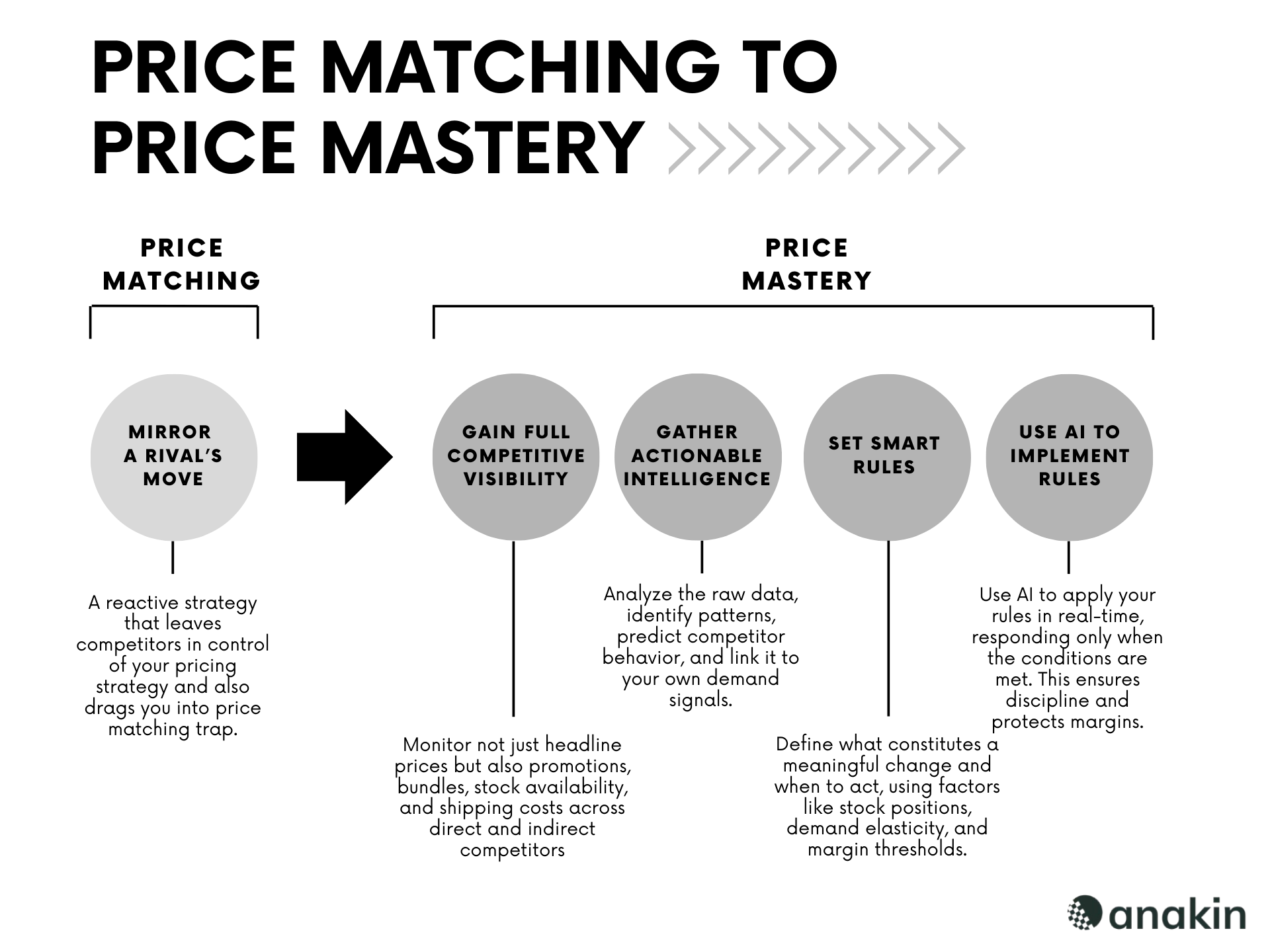
When you're not tracking competitors in detail, you're essentially price matching blind. Full competitive visibility means going beyond prices. You need to monitor promotions, stock levels, shipping costs, and even bundled offers to understand the market climate.
Full competitive visibility also means tracking beyond "big players". Instead of just focusing on the Amazons and Walmarts, include regional and niche competitors. They often influence buying decisions just as much, sometimes even more.
For example, imagine you are tracking only Amazon's pricing on the Samsung Galaxy S25 Ultra. On paper, your prices look aligned. But a smaller competitor offers the product at a slightly lower price, paired with 0% interest when paid in 3 installments.
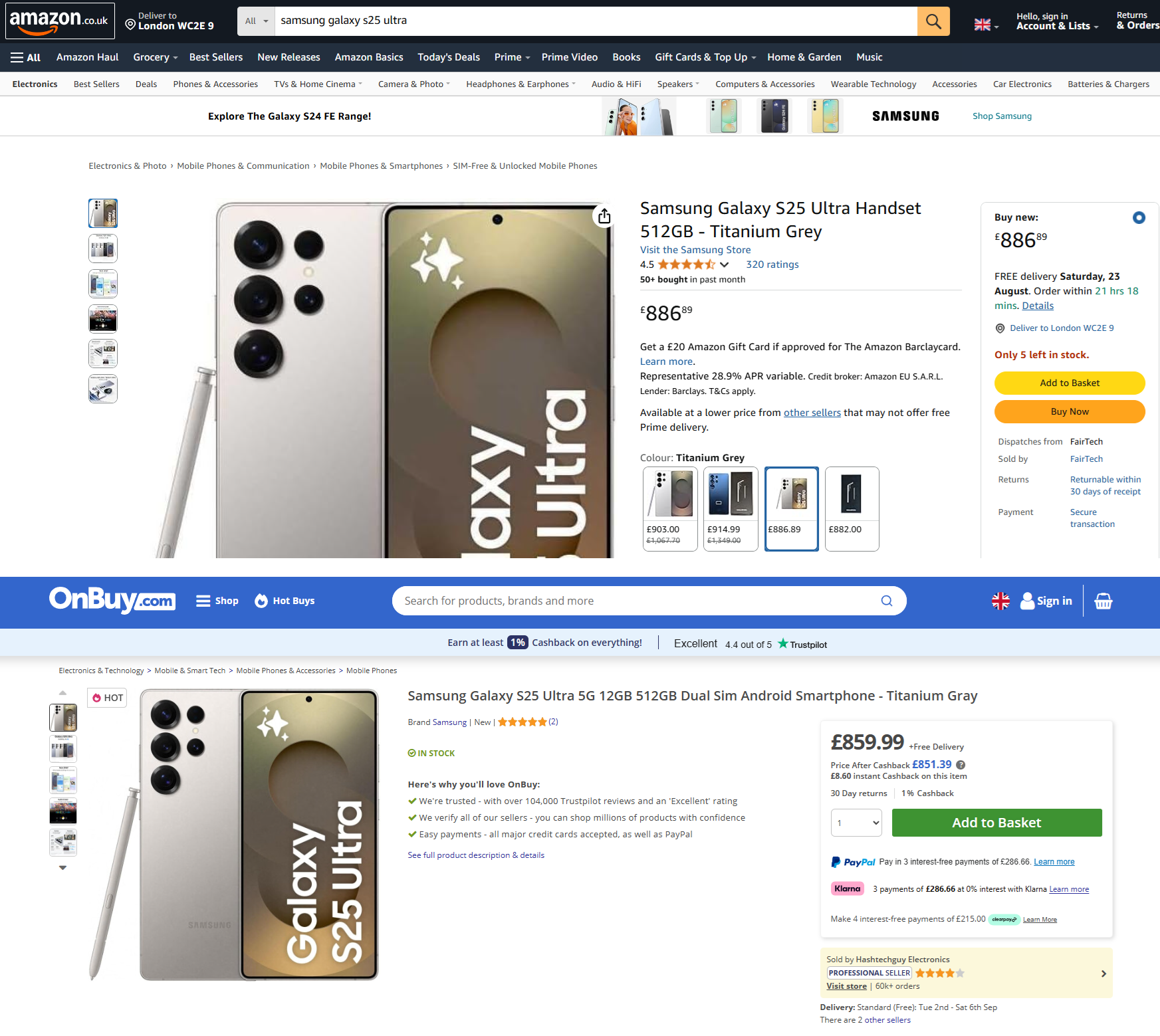
Since you weren't monitoring smaller players, you missed this competitive edge. The result? Customers slowly shift toward the competitor (despite being lesser-known) because of the higher perceived value.
Data in its unprocessed form is often messy and too fragmented to drive real business decisions. You need fresh, accurate, cleaned, and tagged data that's immediately usable for making pricing decisions.
Let's simplify the above statement with an example. Knowing that a competitor dropped prices on a laptop is raw data. Actionable intelligence, on the other hand, tells you whether it was a temporary promotion or if stock levels were constrained. This level of clarity allows you to respond with precision, not guesswork.
Pricing platform like Anakin can help with this. Anakin delivers relevant, comprehensive, and always up-to-date competitive data, giving you a crystal-clear view of the market. This data forms the foundation for your pricing teams to break free from guesswork, anticipate competitor moves, and build pricing strategies that lead rather than react.
What makes Anakin even more powerful is its ability to extract prices till the very end of the funnel. This includes elements like taxes, coupons, and platform-specific discounts that buyers usually see before checkout. By factoring in these final prices, not just the shelf price, you gain a true comparison of competitor strategies and can make more precise pricing moves.
The data you gathered in the previous step should be carefully analyzed. Not all price changes warrant a reaction. Many of these moves are just noise: temporary clearance discounts or seasonal promotions. Without clear rules to separate signal from noise, your pricing teams will be left chasing every fluctuation.
So, set up rules that define what constitutes a meaningful move. The rules should go beyond prices available on the competitor website. They must account for stock positions, demand elasticity, and competitor behavior patterns, ensuring that pricing decisions align with business realities. Equally important are guardrails - rules designed to protect margins and brand value.
Finally, use an AI-driven pricing platform to enforce these rules at scale. They integrate competitive data with your predefined rules and apply advanced machine learning models to determine when to adjust prices versus when to hold steady. Their objective is not just speed, but precision.
By continuously analyzing demand signals, elasticity thresholds, and competitor movements, these platforms execute price changes with great accuracy. Platforms like Pricen let you set pricing rules based on your objectives, market conditions, and customer demand. Pricen also lets you set up dynamic AI-powered filters to select products for different strategies and automatically make sure they are assigned to the right one based on scenarios you have built.
By combining broad, high-quality competitive data with disciplined, AI-driven execution, you will gain the ability to shape your own market narrative. Platforms like Anakin ensure your data foundation is clean, comprehensive, and actionable, while platforms like Pricen use the data to execute your pricing strategy with precision. Together, they help you make smarter pricing moves, steering clear of the price-matching trap, and building long-term profitability.
Written by Anakin Team