

Every retail pricing team faces the same trap. Automate repricing and risk a race to the bottom. Don't automate and fall behind competitors who update prices in real-time. The middle ground—half-automated systems with constant manual oversight—burns through team capacity without delivering real competitive advantage.
By the end of 2026, more than 70% of European retailers are expected to operate with some form of real-time pricing automation. Not because they solved the margin-erosion problem, but because staying competitive without automation is no longer viable. The question isn't whether to automate. It's how to automate without losing control.
Manual repricing works until it doesn't. A pricing analyst can realistically manage price updates for 200-300 SKUs if they're checking competitor prices daily and making adjustments based on pre-defined rules. That's about 3-4 hours of work per day just monitoring and updating.
At 1,000 SKUs across 5 competitor sites, the math breaks. Even if the analyst only adjusts 10% of prices daily (100 SKUs), that's still 500 competitor data points to check, log, and evaluate. By the time they finish Wednesday's price checks, Thursday's competitive landscape has already shifted.
At 10,000 SKUs? The problem isn't just capacity. It's decision latency. Manual processes introduce a 24-48 hour lag between when a competitor changes their price and when you respond. In fast-moving categories—consumer electronics, fashion, grocery—that lag costs sales, margin, or both.
The shift from daily manual price updates to real-time automated repricing reduces pricing team workload by 50-60%, but only when the system operates within defined strategic parameters. Without those parameters, automation just accelerates bad decisions.
Most retailers think automated repricing means "automatically match the lowest competitor price." That's not repricing. That's surrendering pricing strategy to whoever is willing to operate at the lowest margin.
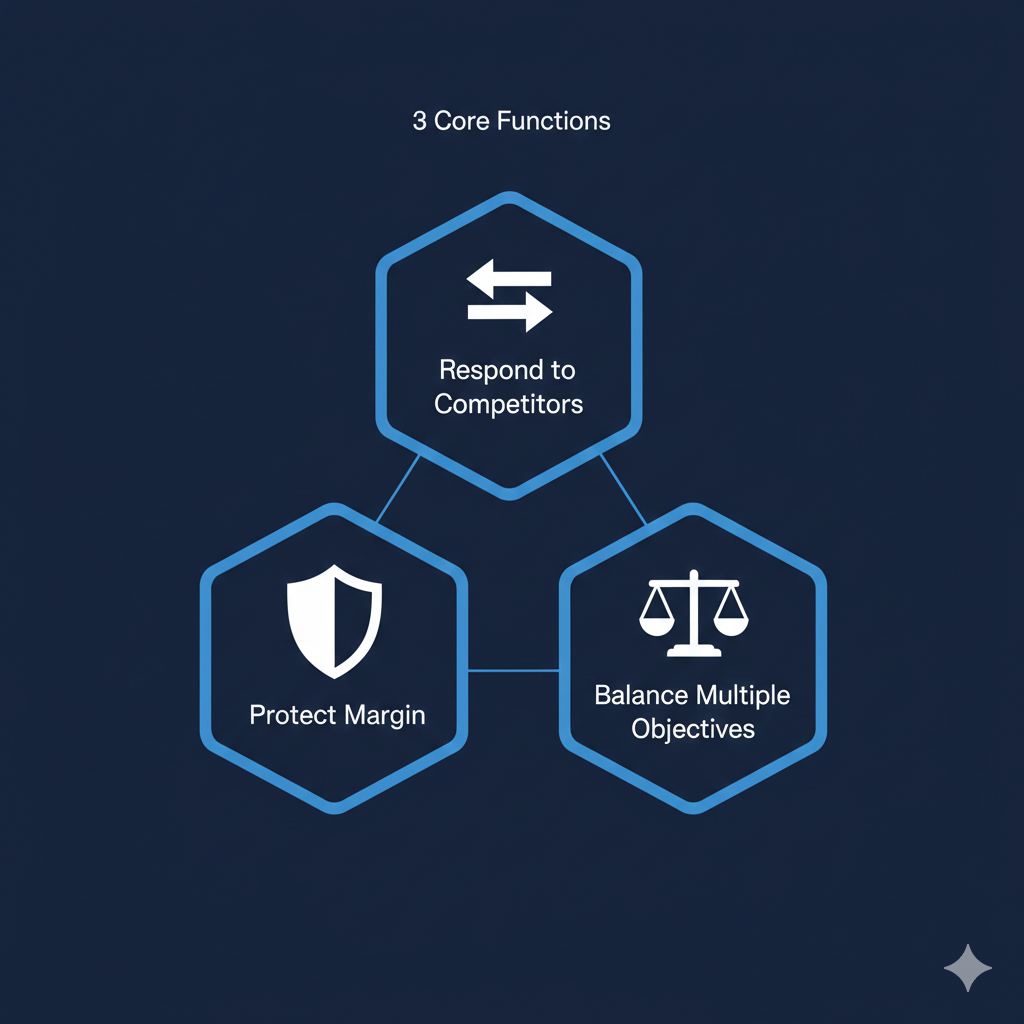
Effective automated repricing does three things simultaneously:
1. Respond to Competitive Moves Without Manual Intervention
When a competitor drops their price on a key SKU, your system needs to evaluate the change, determine the appropriate response based on your rules, and execute the new price—all within hours, not days.
This doesn't mean matching every price drop. It means having logic that says: "If Competitor A (who we track closely) drops below our price by more than 5% on a top-100 SKU, and we have margin room, close the gap to 3% below them. Otherwise, hold."
2. Protect Margin by Enforcing Floor Prices
Retailers without proper floor-price guardrails lose an average of 8-12% in margin within the first 90 days of implementing automated repricing. The algorithm chases competitor prices downward, ignoring cost structure, and pricing teams don't catch it until quarterly margin reviews.
Floor prices aren't just "cost + 5%." They're dynamic. If your cost changes (supplier pricing, freight, tariffs), your floor must update automatically. If your fulfillment method changes (FBA vs. FBM, warehouse A vs. warehouse B), your floor needs to account for that.
3. Balance Multiple Objectives Simultaneously
You're not just optimizing for "lowest price" or "highest margin." You're balancing:
Automated repricing that only considers one variable produces one-dimensional results. You'll win on price and lose on profitability, or protect margin and lose market share.
Most implementations fail because teams try to automate everything at once. The right approach is iterative: start small, prove the logic, then scale.
Step 1: Select a Test Category (Start with 100-200 SKUs)
Don't roll out automated repricing across your entire catalog on day one. Pick one category where:
Consumer electronics, apparel, or grocery staples are good candidates. Avoid categories with MAP pricing or complex promotional cycles until you've proven the system works.
Step 2: Define Your Pricing Rules and Guardrails
Before automation runs, you need to define:
These aren't suggestions. They're hard limits. If a competitor drops their price so low that matching would violate your floor, the system holds your price and flags it for review.
Step 3: Integrate Competitive Price Data
Your repricing system needs real-time competitor price feeds. If you're checking competitor prices manually and uploading CSVs once a day, your "automated" repricing is still manual at the data layer.
Most pricing platforms integrate with competitive intelligence tools that scrape competitor sites every 2-6 hours and feed that data directly into your repricing logic. You're not building the scraper. You're consuming the data feed.
Step 4: Set the Automation Cadence
How often should prices update? It depends on your category:
More frequent updates aren't always better. If your competitor changes prices hourly and you match every change, you're in a reactive loop. Set a cadence that's fast enough to stay competitive but slow enough to avoid knee-jerk responses.
Step 5: Monitor, Measure, Adjust
In the first 30 days, review every automated price change daily. Look for:
After 30 days, move to weekly reviews. After 90 days, you should trust the system enough to only intervene when alerts fire.
Guardrails are what separate smart automation from destructive automation. Without them, automated repricing becomes a race to whoever is willing to operate at the lowest margin.
Floor Price Logic
Your floor isn't static. It adjusts based on:
Most retailers set floor = cost + 15% and call it done. That's better than no floor, but it doesn't account for variable costs. A better approach: floor = (product cost + fulfillment cost + allocated overhead) * (1 + minimum margin %).
Ceiling Price Logic
Ceilings prevent your system from overpricing when competitors go out of stock or stop selling a SKU. Common ceiling approaches:
If no competitors are in stock and your system has no ceiling, it might raise your price to absurd levels. The ceiling prevents that.
Margin Thresholds by Category
Not all categories should have the same margin target. Your automated repricing should enforce category-specific thresholds:
If the system can't maintain the category margin threshold while staying competitive, it flags the SKU for manual review rather than auto-lowering the price.
The most common repricing failures happen in the first 90 days. Here's what to avoid:
Mistake 1: Automating Without Competitor Context
Your system matches competitor prices, but you don't know which competitors matter. You end up matching a liquidator who's dumping inventory at a loss, or a marketplace seller with counterfeit goods.
Fix: Define your competitive set explicitly. Track 3-5 primary competitors you actually care about and ignore the long tail of irrelevant sellers.
Mistake 2: No Floor Price, or Floor Set Too Low
You set floor = cost, forgetting that cost doesn't include fulfillment, overhead, or returns. Within 60 days, you're losing money on 15-20% of sales without realizing it.
Fix: Floor = all-in cost * (1 + minimum acceptable margin). Update floors automatically when costs change.
Mistake 3: Reacting to Every Competitor Move
Competitor A drops their price. You match. They drop again. You match again. Within a week, you're both at 50% of the original price and neither of you is profitable.
Fix: Set a "change threshold." Only reprice if the competitor's move is meaningful (e.g., more than 5% price gap, or they undercut you on a top-100 SKU). Ignore noise.
Mistake 4: Ignoring Stock and Availability
You match a competitor's low price. They're out of stock. You just lowered your price for no competitive reason because the "competitor" isn't actually competing.
Fix: Repricing logic should check stock status. If the competitor is out of stock, don't react to their price.
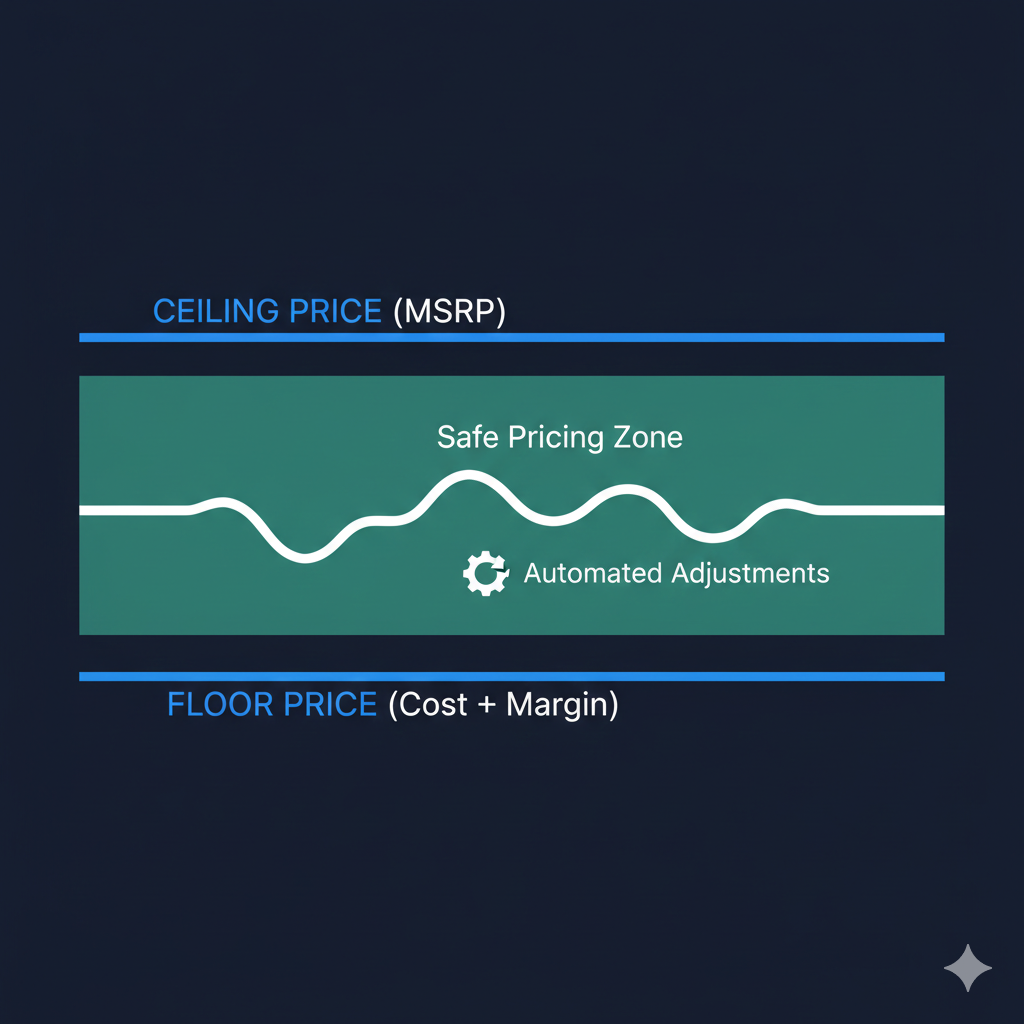
Destructive automation chases the lowest price without regard for margin, competitive context, or strategic positioning. Smart automation operates within guardrails and optimizes for multiple objectives.
Here's the difference:
Destructive Automation:
Smart Automation:
Destructive Automation:
Smart Automation:
Destructive Automation:
Smart Automation:
The goal of automated repricing isn't to remove humans from pricing decisions. It's to remove humans from the repetitive, low-value work of checking hundreds of prices daily and making obvious adjustments. Strategic decisions—floor prices, competitive positioning, category margin targets—still require human judgment.
Anakin provides the real-time competitive price data that feeds smart automated repricing systems. If you're monitoring competitor prices across 100+ platforms and need accurate, real-time data to power your repricing logic without racing to the bottom, we can help.