

There’s a war happening in your market right now.
You’re in it. Your competitors are in it. Your customers are caught in the middle. And almost nobody sees it clearly.
This isn’t a war fought with better products. It isn’t even won with better marketing. Those still matter—but they are no longer decisive.
The real battle is being fought on something far less visible, yet far more powerful: information timing.
We’ve all heard the phrase: “The best product wins.”
It feels true because, historically, it was. But in today’s markets—especially in e-commerce, quick commerce, and digital marketplaces—that belief is incomplete.
Because the best product doesn’t always win anymore.
The best-informed company does.
Competition today doesn’t unfold through big, visible moves. It happens quietly, in ways that rarely get noticed but constantly reshape outcomes. A competitor lowers prices in a few key regions without drawing attention. Another introduces bundles around high-performing SKUs. Somewhere else, a seller goes out of stock at exactly the wrong moment, creating a short-lived gap. Delivery fees are adjusted just enough to influence buying decisions.
None of these changes trend. None go viral.
But together, they continuously shift the market.
If you don’t see them when they happen, you don’t respond. And if you don’t respond, you don’t lose dramatically—you lose gradually.
Not because you were worse.
Because you were late.
We often describe modern markets as fast-moving, but that framing is misleading.
Markets don’t move fast. They move unevenly.
Changes don’t happen everywhere at once. Prices shift in pockets before spreading. Stockouts appear in specific regions before becoming widespread. Demand doesn’t rise uniformly; it concentrates in bursts—across categories, geographies, and time windows.
This uneven behavior creates constant micro-opportunities and micro-losses.
Most companies are built to optimize for averages. They rely on aggregated data, weekly summaries, and stable trends. But the real dynamics of competition don’t live in averages.
They live in deviations.
The companies that win are the ones tracking where reality is changing first—not where it has already stabilized.
When your data is delayed, fragmented, or outdated, the damage goes far beyond missing insights.
You start making decisions that are slightly misaligned with reality.
You adjust pricing based on yesterday’s competitor moves. You plan inventory using signals that are no longer accurate. You forecast demand without visibility into where it’s actively shifting. You expand into categories without understanding where real gaps exist right now.
Each of these decisions seems reasonable on its own.
But together, they create a system that is always just behind the market.
And that lag compounds.
What makes this especially dangerous is that the loss is hard to trace. It doesn’t show up as a single failure. Instead, it appears as declining conversion rates, subtle margin erosion, and unpredictable churn.
Most teams attribute these outcomes to “market conditions.”
In reality, they’re symptoms of delayed awareness.
For years, companies believed their biggest challenge was access to data.
That problem has largely been solved.
Today, data is everywhere—APIs, dashboards, analytics tools, and internal systems generate more information than teams can fully process. But having data is no longer the advantage.
Timing is.
The real question is simple: how fast does your data reflect reality?
If your systems show what happened yesterday, you are analyzing history. If they show what is happening now, you are operating in the present.
That distinction defines how a company behaves.
It determines whether you react after changes occur or move while they are still unfolding. Whether decisions are based on assumptions or grounded in current truth. Whether you follow the market or quietly stay ahead of it.
One of the most common mistakes companies make is treating competitive intelligence as a tool.
A dashboard to check. A report to review. A meeting to discuss insights.
But real-time intelligence is not something you “use” occasionally. It is something your entire system should run on.
It should continuously inform pricing, merchandising, supply chain decisions, and growth experiments. Not in weekly intervals or monthly reviews, but as an always-on layer embedded into operations.
At a certain level of maturity, companies stop “checking competitors.”
They start tracking the market as a living system.
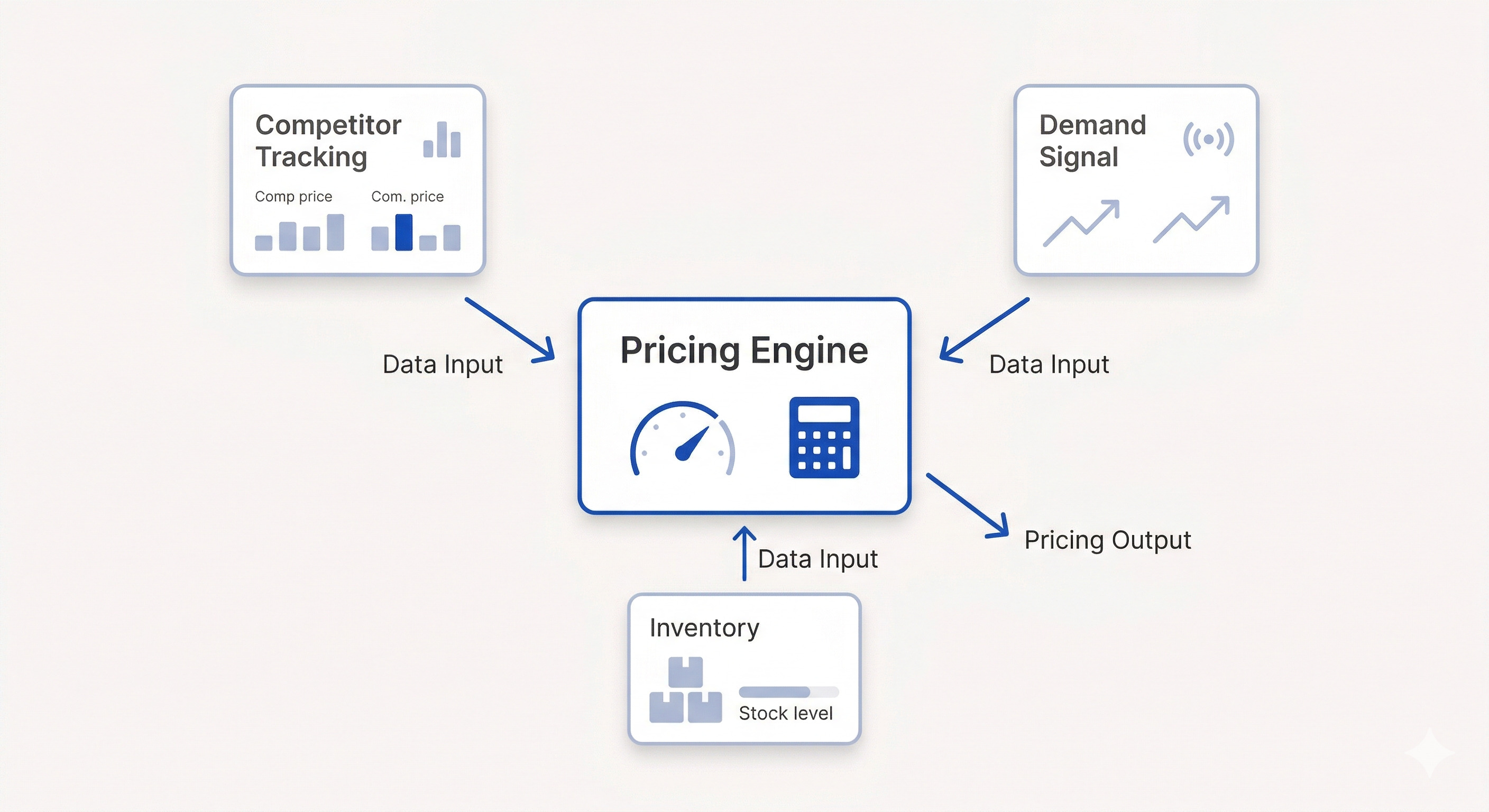
Most intelligence workflows were designed for a slower era.
They follow a predictable sequence: data is collected, cleaned, structured, analyzed, and then shared. Each step introduces delay. By the time insights reach decision-makers, they are already outdated.
This delay is not just inefficient—it is the core failure point.
Because in dynamic markets, timing consistently beats depth. A slightly imperfect insight delivered immediately is far more valuable than a perfectly refined insight delivered too late.
Yet many organizations are still optimizing for accuracy at the cost of speed, without realizing that the tradeoff is no longer acceptable.
The next generation of companies is shifting away from periodic decision-making.
They don’t operate in review cycles. They operate in continuous loops.
Instead of asking, “What did competitors do this week?” they build systems that alert them the moment competitiveness is lost in any segment. Instead of analyzing stockouts after the fact, they monitor them in real time and act immediately. Instead of planning assortments quarterly, they identify and respond to emerging gaps as they appear.
This transforms decision-making from isolated events into a constant stream.
Once that shift happens, responsiveness becomes embedded in the organization itself. Decisions are no longer delayed by process—they are triggered by reality.
Another common assumption is that more data leads to better decisions.
In practice, the opposite is often true.
More data can create more noise, more confusion, and more room for error. What actually matters is precision—how accurately your data represents the real world.
High-volume, low-quality data leads to hesitation and missteps. High-precision, structured data leads to clarity and confident action.
This becomes especially critical in real-time systems. Without precision, speed becomes a liability. You don’t just move faster—you make mistakes faster.
The goal is not to know more.
It is to know what matters, exactly when it matters.
In today’s environment, many traditional advantages have flattened.
Product quality is expected. Marketing efficiency is crowded. Distribution advantages are increasingly commoditized.
What remains is reaction speed.
How quickly can you adjust pricing when competitors move? How fast can you capture demand when someone else runs out of stock? How effectively can you move into gaps before they become obvious to everyone else?
These are no longer operational questions—they are strategic ones.
The companies that win consistently are not always the most innovative or the most creative.
They are the fastest to act on what is true.
One of the most important perspective shifts is understanding what you are actually competing against.
It’s not just products.
It’s systems.
Your competitors are constantly testing pricing, adjusting inventory, experimenting with offers, and expanding assortments. What determines their success is not any single move, but how quickly and effectively they can make those moves.
In other words, you are competing against their decision velocity.
If their system reacts faster than yours, they gain ground—quietly, consistently, and often invisibly.
The direction of the market is clear.
We are moving beyond real-time dashboards toward autonomous decision systems—systems that don’t just surface insights, but act on them.
Pricing adjusts automatically based on competitive signals. Inventory decisions are triggered by live stock patterns. Promotions launch in response to real-time demand spikes. Assortments expand based on continuous gap detection.
These systems operate in loops, not snapshots.
But they only work when the underlying data is real-time, accurate, continuous, and deeply integrated into the business.
Without that foundation, automation simply amplifies delays.
The market is not waiting.
It is updating constantly—prices shifting, inventory changing, competitors acting in ways that rarely become visible at the surface.
Every gap between what is happening and when you respond is where you lose.
Not in obvious ways, but in small, compounding ones that build over time. Until one day, the gap becomes impossible to ignore—and it feels sudden, even though it wasn’t.
There are now two types of companies:
Those who analyze the market, and those who move with it.
Only one of them wins consistently.
So the real question isn’t whether you have data.
It’s whether your data is describing the past…
or driving the present.