

Walmart CEO, Doug McMillon, once quoted at a shareholder's meeting "Price still matters. There are a lot of Americans that are counting every penny and every dime."
On the surface, this sounds like a simple observation, but beneath it lies a powerful truth about consumer behavior in the grocery industry -
A single cent can tip the scales in this industry, with the player who nails pricing emerging as the true winner of the 'Battle for the Aisles.
To complicate things further, the grocery industry comes with its own set of unique challenges. Perishability is a constant pressure. Fresh produce, dairy, and meat can lose value by the hour, leaving no room for slow or inefficient price updates. Substitution is another concern. Shoppers effortlessly switch between private labels and national brands if they feel pricing is off, making loyalty highly fragile.
And just when everyone thought that the grocery pricing game couldn't get any more complex and intense, the rise of Q-commerce and hyperlocal delivery pushed it into overdrive.
Earlier, grocery pricing was a relatively slower game. Prices were updated weekly, maybe daily at best (particularly in online stores), to reflect market conditions. Today, that timeline feels snail-paced, thanks to the rise of Quick commerce, where pricing shifts multiple times a day, even hourly in some cases.
A slight mismatch or delay in price change can send customers straight into your competitor's basket. A quick recommendation - Don't rely on lagging price reports; you need constant access to live, actionable intelligence that guides your every price move.
The battlefield has also expanded beyond physical shelves. Today, your competitor might still be the store across the street. But they could just as easily be an app serving customers from the other end of the city. This change has made hyperlocal price intelligence a critical part of grocery pricing.
At Anakin, we've worked with some of the best in the grocery industry, and they all unanimously agree - winning in this space isn't about having the lowest price everywhere; it's about having the right price, in the right place, at the right time, whether that's in-store, online, or q-commerce.
And mastering this level of precision requires a fundamental shift in approach - a transition from reacting to market changes to predicting them before they change.
That's why we framed our very own Pricing Intelligence Framework, a 4-step model designed to help grocery retailers like you move beyond firefighting price changes and instead influence the market on your own terms.
This framework simplifies complex pricing decisions into four actionable steps. Using this, you will have the clarity and control needed to consistently edge out competitors:
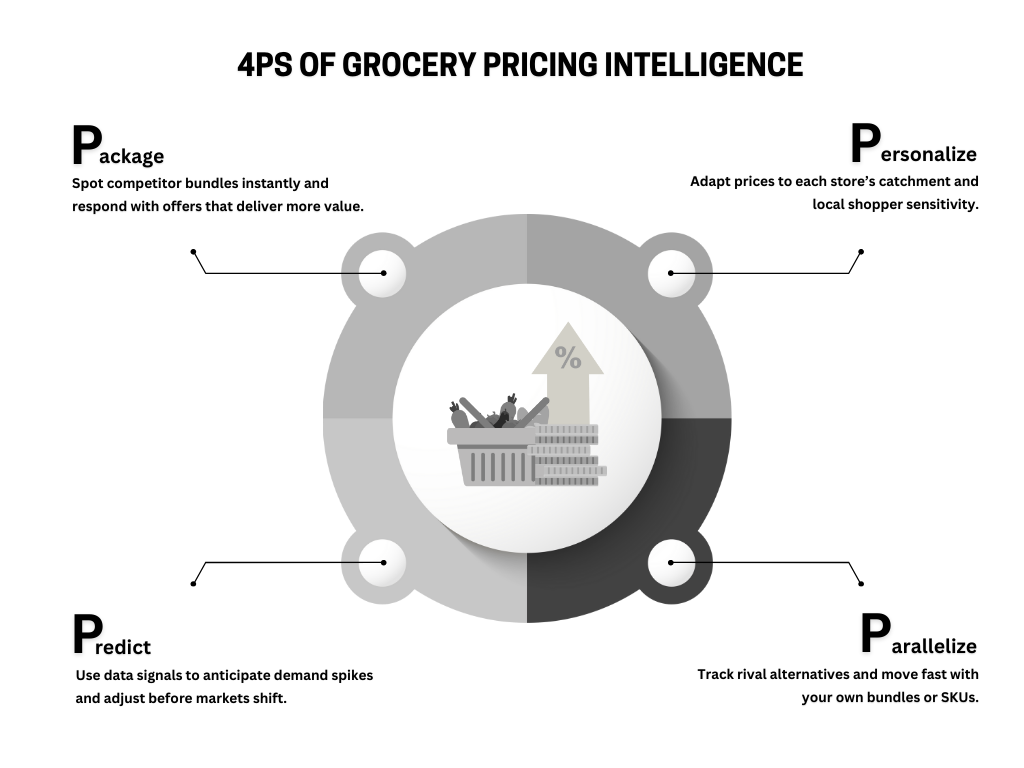
Shoppers love bundles that offer convenience and savings. The challenge isn't just knowing these promotions exist. It's detecting them and responding quickly.
For example, on the Friday before Thanksgiving, a competitor might launch a "Holiday Dinner Bundle" featuring turkey, stuffing mix, cranberry sauce, and pumpkin pie. If you detect this only after the weekend rush, the opportunity is already lost.
With Anakin, you get total visibility on how your competitors are bundling products, enabling you to respond quickly with similar or improved bundles. For instance, you could roll out your own holiday bundle with turkey, sides, and a free dessert add-on, helping you capture the holiday shoppers.
Outcome: Drive higher basket value with timely, compelling promotions that capture shopper attention before they walk away.
When our team first dug into regional pricing data for a major grocery client, we found something eye-opening: two stores barely 10 miles apart had completely different competitive landscapes and price sensitivity levels. This was confirmed by a survey comprising grocery retailers, 25% of products had over 20% price variation across ZIP codes, even within the same city.
This made it quite clear: hyperlocal price zoning is not just an idea on paper; it's a necessity today in the grocery industry. By tailoring prices to micro-markets and store catchment areas, you can stay razor-sharp against local competitors in highly price-sensitive areas.
Outcome: Capture local market share with pricing tailored to the sensitivity and demand of each neighbourhood.
Festivals, weather events, wars, supply chain disruptions, etc., can all send grocery prices into a frenzy. And when you're caught off guard, it's not just margins that take a hit; your customers feel the shock too.
But here's the thing: the warning signs are almost always hiding in the data. Today's pricing intelligence platforms can use historical sales patterns, supply data, and external market signals to forecast seasonal price spikes before they happen.
Consider mangoes, a highly seasonal product with strong demand spikes. Historical data accumulated over the years can reveal deep insights about mango prices. By analyzing parameters such as festival calendars, regional consumption patterns, weather conditions, and competitor pricing, predictive intelligence models can accurately determine demand spikes and the optimal price thresholds without risking customer attrition.
Outcome: Anticipate demand surges and make changes to your own prices, protecting margins while keeping customers loyal.
Your competitors aren't always targeting you with identical SKUs. They often use substitutes to appeal to the same shopper need. A customer looking for basmati rice might be swayed by your competing brand's premium jasmine rice at a lower price.
Tracking close substitutes, not just exact matches, is the final key to boosting your sales. Pricing intelligence platforms can identify when a rival is pushing an alternative product in your category and recommend counter-moves like adjusting your price, offering a bundle, or promoting your own alternative SKU. This ensures you're competing on the need, not just the product label.
They can also reveal gaps between private labels and branded products. Customers often view these items as substitutes. This means even small price differences can sway purchasing decisions. Through advanced product matching, you can align similar products across categories, for example, comparing your store's private-label cereal with a leading national brand. This helps identify whether the private label is priced competitively, overpriced, or undervalued, allowing you to adjust strategies accordingly.
Outcome: Strike the perfect balance between value perception and profitability, ensuring you win a greater basket share for every customer.
The next chapter of grocery pricing will certainly be defined by precision and personalization powered by AI.
Predictive intelligence will allow retailers like you to anticipate market movements, competitor actions, and even shopper intent before they happen. But the real winners will be those who ensure omnichannel pricing consistency, whether a customer is shopping in-store, on an app, or via a quick commerce platform, while utilizing the above framework to price better.
In a space where competition is only intensifying, the ability to respond dynamically and intelligently to shifting market signals will be the difference between keeping up and leading the pack.
Written by Anakin Team